
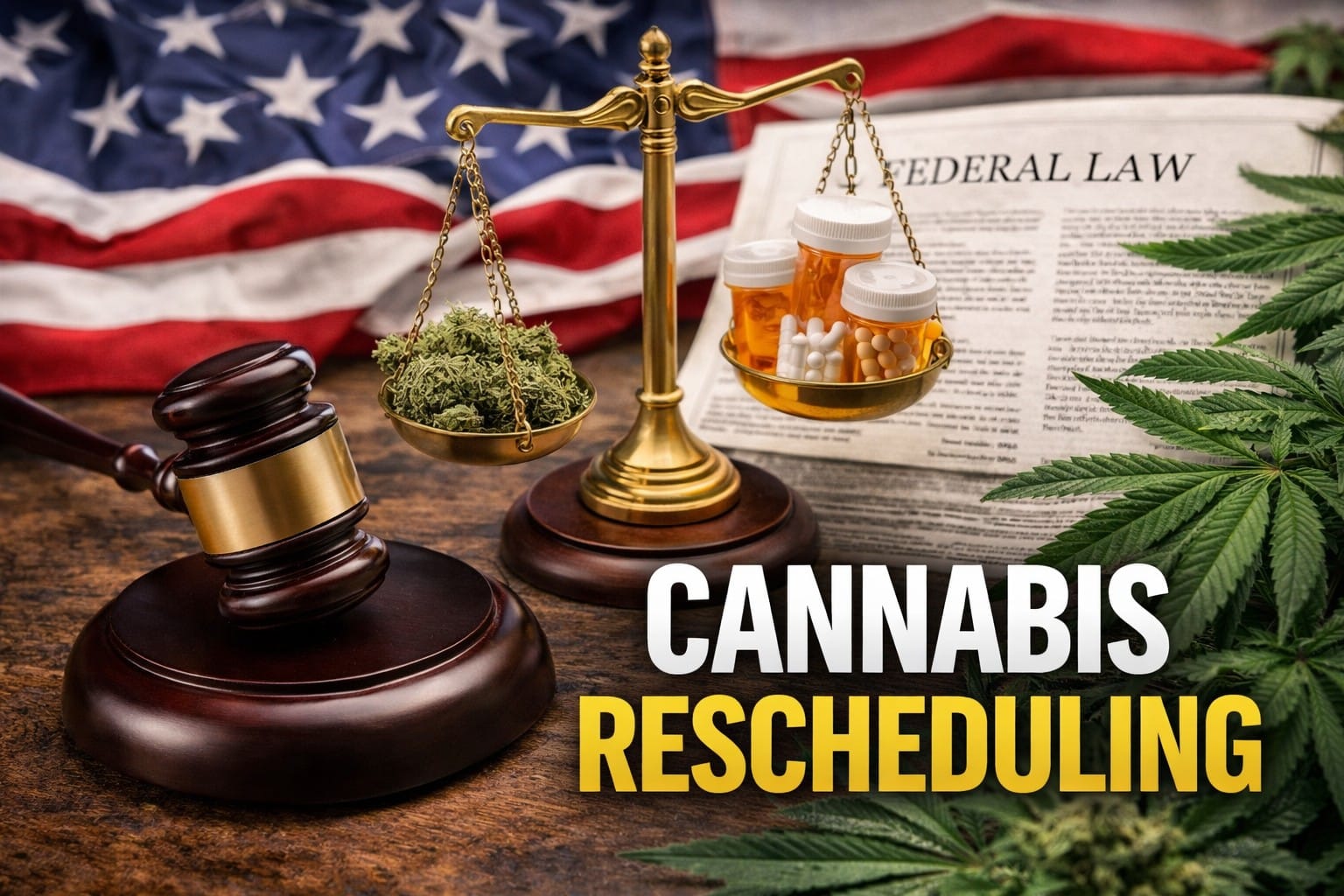
What does “cannabis rescheduling” mean?
In the U.S., the Controlled Substances Act (CSA) groups drugs into schedules (I–V). Rescheduling means moving cannabis from one schedule to another—changing how it’s regulated at the federal level.
Right now, the big headline is the potential move from Schedule I to Schedule III—often called “Schedule III marijuana” or “marijuana rescheduling.” (Federal Register)
What changed recently?
On December 18, 2025, President Donald Trump signed an executive order focused on increasing medical marijuana and CBD research and directing the Department of Justice to move the rescheduling process forward as quickly as the law allows. (The White House)
This followed the earlier federal process:
May 21, 2024: DOJ/DEA published a proposed rule to move marijuana to Schedule III in the Federal Register. (Federal Register)
The White House EO page notes the proposed rule drew nearly 43,000 comments during the rulemaking process. (The White House)
A Congressional Research Service (CRS) summary noted that final action had not been taken at the time of the executive order (and the timing remains uncertain). (Congress.gov)
Bottom line: The executive order is a major signal and a push to finish the process—but it doesn’t automatically legalize cannabis nationwide or instantly “flip a switch” on federal scheduling without completing the required rulemaking steps. (Congress.gov)
Does rescheduling mean cannabis is federally legal?
No. Rescheduling is not federal legalization. Cannabis would still be a controlled substance under the CSA if moved to Schedule III—just regulated differently than Schedule I. (Congress.gov)
That also means:
Massachusetts adult-use cannabis stays legal under MA law, and MA rules (ID checks, purchase limits, testing, packaging, etc.) still apply day-to-day.
Federal changes don’t automatically rewrite workplace rules for safety-sensitive jobs (like DOT-regulated roles). (DISA)
Why Schedule III matters to cannabis businesses
The biggest industry impact people talk about is 280E.
1) 280E tax relief (the headline issue)
IRS Code Section 280E blocks standard business deductions for companies “trafficking” Schedule I or II controlled substances. If cannabis moved to Schedule III, many observers expect 280E would no longer apply the same way—potentially a huge financial shift for licensed operators. (Shipman – Homepage)
(Important: How this plays out in practice can involve timing, guidance, and tax planning—so businesses should talk with cannabis-savvy tax professionals.)
2) More research (and potentially faster medical progress)
Schedule I status creates major barriers for researchers. The December 18, 2025 executive order and the broader rescheduling effort are explicitly framed around expanding research access and coordination. (The White House)
3) Banking and broader finance
Rescheduling could reduce friction in some areas, but it’s not a guaranteed “banking fix” on its own—financial institutions still have to manage federal compliance risk. (Congress.gov)
What it could mean for customers in Massachusetts
For shoppers, don’t expect immediate changes like:
Lower prices overnight
New purchase limits
Cannabis becoming legal to transport across state lines
Those things are more tied to federal legalization, interstate commerce rules, and state-by-state frameworks—not rescheduling alone. (Congress.gov)
What you might see over time, if Schedule III is finalized:
More research-backed product development and medical data
Industry stability if 280E relief improves operator economics (Shipman – Homepage)
Where rescheduling stands now
As of January 2026, the public record still reflects an ongoing federal process (proposed rule + procedural steps) rather than a fully completed change with clear implementation dates. (Congress.gov)
FAQ
Will rescheduling make weed legal everywhere?
No. Rescheduling ≠ legalization. (Congress.gov)
If it becomes Schedule III, can dispensaries ship across state lines?
Not automatically. Interstate sales raise separate federal/state legal issues. (Congress.gov)
Does rescheduling change drug testing rules?
Not automatically—especially for DOT-regulated or safety-sensitive roles. (DISA)
Local note: Shopping in Lynn, MA
Massachusetts is already an adult-use market—so if you’re shopping in Lynn, the biggest “customer experience” changes from rescheduling are likely to be indirect (research, industry economics, long-term product innovation), not immediate changes at checkout.
21+ only with valid ID.
 Massachusetts Green Retail Inc. offers a wide variety of top-notch recreational products at unbeatable prices, all while staying committed to our local roots! Shop online for pickup and come visit us to discover not only amazing deals but also a friendly atmosphere where our knowledgeable team is ready to help you find exactly what you need for a great experience.