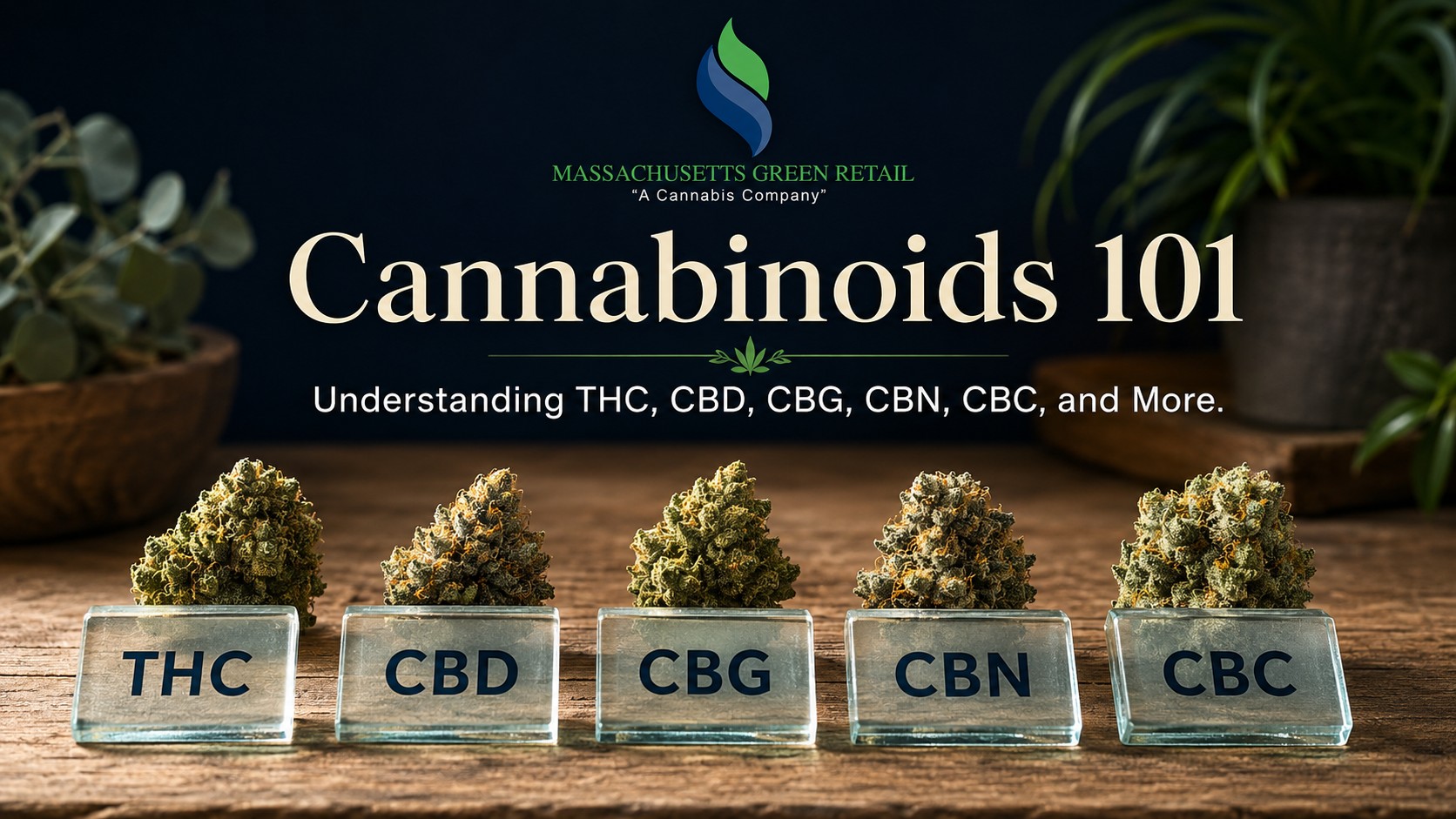
Cannabis labels can sometimes look like an alphabet lesson.
THC and CBD are familiar to many shoppers, but today’s menus may also mention CBG, CBN, CBC, THCA, CBDA, and other cannabis compounds. Understanding these abbreviations can help you read product information, compare options, and ask better questions during your next dispensary visit.
Cannabinoids are naturally occurring compounds found in cannabis. Researchers have identified many different cannabinoids, although THC and CBD remain the most extensively studied. Each compound has a different chemical structure and may interact with the body differently. However, research into many minor cannabinoids remains limited. (National Institute on Drug Abuse)
At Massachusetts Green Retail, we believe cannabinoid information should be useful—not overwhelming. Here is a straightforward introduction to some of the cannabinoids you may encounter while shopping.
THC: The Primary Intoxicating Cannabinoid
THC stands for tetrahydrocannabinol. When people describe the intoxicating or “high” effects associated with cannabis, they are generally referring to delta-9 THC.
THC can affect perception, coordination, memory, attention, and reaction time. The experience can vary considerably depending on the product, serving amount, method of consumption, individual tolerance, and other factors. (National Institute on Drug Abuse)
A higher THC percentage does not automatically mean a product is higher quality or that it will be the best option for every customer. Potency is only one part of the overall product.
When comparing cannabis, it can also be helpful to consider:
Product format
Serving size
Terpene profile
Cannabinoid balance
Aroma and flavor
Previous experience
Personal tolerance
New or infrequent consumers should approach high-THC products carefully and begin with a low amount.
CBD: A Nonintoxicating Cannabinoid
CBD stands for cannabidiol.
CBD does not produce the same intoxicating effects associated with THC. It may appear in flower, edibles, tinctures, capsules, topicals, and products containing a combination of THC and CBD. (National Institute on Drug Abuse)
Products may be described using ratios such as:
1:1 THC to CBD
2:1 CBD to THC
5:1 CBD to THC
CBD-dominant
THC-dominant
A ratio tells you how the amounts of the two cannabinoids compare. For example, a 1:1 product contains approximately equal amounts of THC and CBD per labeled serving.
CBD is widely marketed for many purposes, but marketing claims often move faster than the available evidence. The FDA continues to identify unanswered questions about CBD’s safety, long-term use, drug interactions, and product quality. Customers should not assume that an over-the-counter or dispensary product has been proven to treat a medical condition. (U.S. Food and Drug Administration)
CBG: A Less Common Cannabinoid
CBG stands for cannabigerol.
The cannabis plant initially produces acidic cannabinoid compounds. One of them, CBGA, acts as a biological precursor used by the plant to form compounds that eventually become THC, CBD, and CBC. Heat can convert CBGA into CBG. (PMC)
CBG is typically present in smaller quantities than THC or CBD, although growers and manufacturers have developed products specifically marketed for higher CBG content.
You may find CBG in:
Flower
Gummies
Tinctures
Vape products
Capsules
Products combining CBG with THC or CBD
Research into CBG is growing, but much of the available evidence still comes from laboratory or animal studies. Early findings should not be treated as proof that CBG prevents, treats, or cures a health condition. (PubMed)
CBN: A Cannabinoid Associated With Aged THC
CBN stands for cannabinol.
CBN can form as THC changes through oxidation and degradation over time. This is one reason older cannabis may contain more CBN than freshly stored cannabis. Heat and storage conditions can also influence cannabinoid degradation. (PubMed)
CBN is frequently marketed in nighttime products, particularly gummies containing combinations of CBN, THC, CBD, or other ingredients. However, branding a product for nighttime use does not guarantee that it will produce a particular experience.
Research into isolated CBN remains much more limited than research into THC or CBD. Customers should be cautious of strong claims suggesting that CBN has been definitively proven to improve sleep or treat sleep disorders. (PMC)
CBC: An Emerging Minor Cannabinoid
CBC stands for cannabichromene.
CBC is another naturally occurring cannabinoid that may appear in small amounts in certain flower, extracts, and formulated products. It generally receives less consumer attention than THC, CBD, CBG, or CBN.
Scientists are studying how CBC interacts with different biological targets, but human research remains limited. A 2024 scientific review noted that commercial interest in CBC has expanded despite limited evidence regarding its safety and effectiveness. (PubMed)
For shoppers, CBC is best understood as another component of the cannabis plant—not as a guaranteed indicator of a particular benefit or experience.
THCA and CBDA: The Acidic Forms
Cannabis plants produce several cannabinoids first in their acidic forms.
Two abbreviations you may see are:
THCA: Tetrahydrocannabinolic acid
CBDA: Cannabidiolic acid
When exposed to sufficient heat, these acidic cannabinoids undergo a process called decarboxylation. THCA converts toward THC, while CBDA converts toward CBD. This conversion occurs during processes such as smoking, vaping, or controlled heating during manufacturing. (PubMed)
That is why flower labels may show both THC and THCA rather than displaying only one number.
Massachusetts testing protocols define a cannabinoid profile as including measured amounts of compounds such as delta-9 THC, CBD, THCA, and other cannabinoids. (Massachusetts Government)
What About Delta-8 THC?
Delta-8 THC is chemically related to delta-9 THC and may also produce intoxicating effects.
Many delta-8 products sold outside licensed dispensaries are made from hemp-derived CBD through chemical conversion. The FDA has warned that delta-8 THC products have not been evaluated or approved for safe use and has received reports of adverse events involving these products. (U.S. Food and Drug Administration)
Consumers should avoid assuming that a product is safe simply because it is labeled “hemp-derived” or is available outside a licensed cannabis retailer.
How to Read a Cannabinoid Label
When reviewing a cannabis package, look for information such as:
Cannabinoid amount per serving
Total cannabinoid amount in the package
THC or THCA percentage
CBD or CBDA percentage
Ratios between cannabinoids
Suggested serving size
Testing and batch information
For flower, cannabinoids are commonly shown as percentages. Edibles and beverages usually display milligrams per serving and milligrams per package.
Always confirm whether a number refers to one serving or the entire container. A package containing 100 milligrams of THC may be divided into ten individually labeled 10-milligram servings.
Cannabinoids Are Only Part of the Product
Cannabinoid content can help you compare products, but it does not predict every aspect of the experience.
Two products with similar THC percentages can differ in aroma, flavor, terpene profile, cultivation quality, freshness, and format. Individual responses can also vary.
Instead of focusing on a single number, consider telling your budtender:
Which formats you prefer
Whether you are new or experienced
What potency range you are comfortable with
Whether you want THC-dominant, CBD-dominant, or balanced options
Which aromas and flavors you enjoy
What products you have previously liked or disliked
Explore Cannabinoids at Massachusetts Green Retail
Massachusetts Green Retail carries a broad range of flower, pre-rolls, edibles, vape products, concentrates, and other adult-use cannabis products.
Customers looking for a knowledgeable cannabis dispensary in Lynn, MA can visit our store to compare cannabinoid profiles and learn how to read product labels. As a recreational cannabis dispensary serving the North Shore of Massachusetts, we want every customer to feel comfortable asking questions.
Browse our online menu to review current products, cannabinoid information, and available cannabis deals and discounts, then place an order for convenient in-store pickup.
Final Thoughts
THC may be the best-known cannabinoid, but it is not the only compound found in cannabis.
CBD, CBG, CBN, CBC, THCA, CBDA, and other cannabinoids each contribute to a growing area of cannabis science and product development. Some are well studied, while evidence involving others remains preliminary.
Understanding the basics can help you read labels and compare products without relying on exaggerated marketing claims.
Visit Massachusetts Green Retail in Lynn or browse our online menu to explore products with different cannabinoid profiles. Our team is ready to help you understand what is on the label and select an option that fits your preferences and experience level.
Research Status as of July 2026
Scientific knowledge about minor cannabinoids continues to develop. Information about CBG, CBN, CBC, and similar compounds may change as larger and better-controlled human studies become available. Early laboratory findings should not be interpreted as established medical benefits.
 Massachusetts Green Retail Inc. offers a wide variety of top-notch recreational products at unbeatable prices, all while staying committed to our local roots! Shop online for pickup and come visit us to discover not only amazing deals but also a friendly atmosphere where our knowledgeable team is ready to help you find exactly what you need for a great experience.