Cannabis pistils are reproductive structures found on female cannabis flowers.
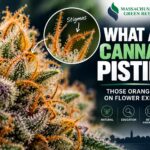
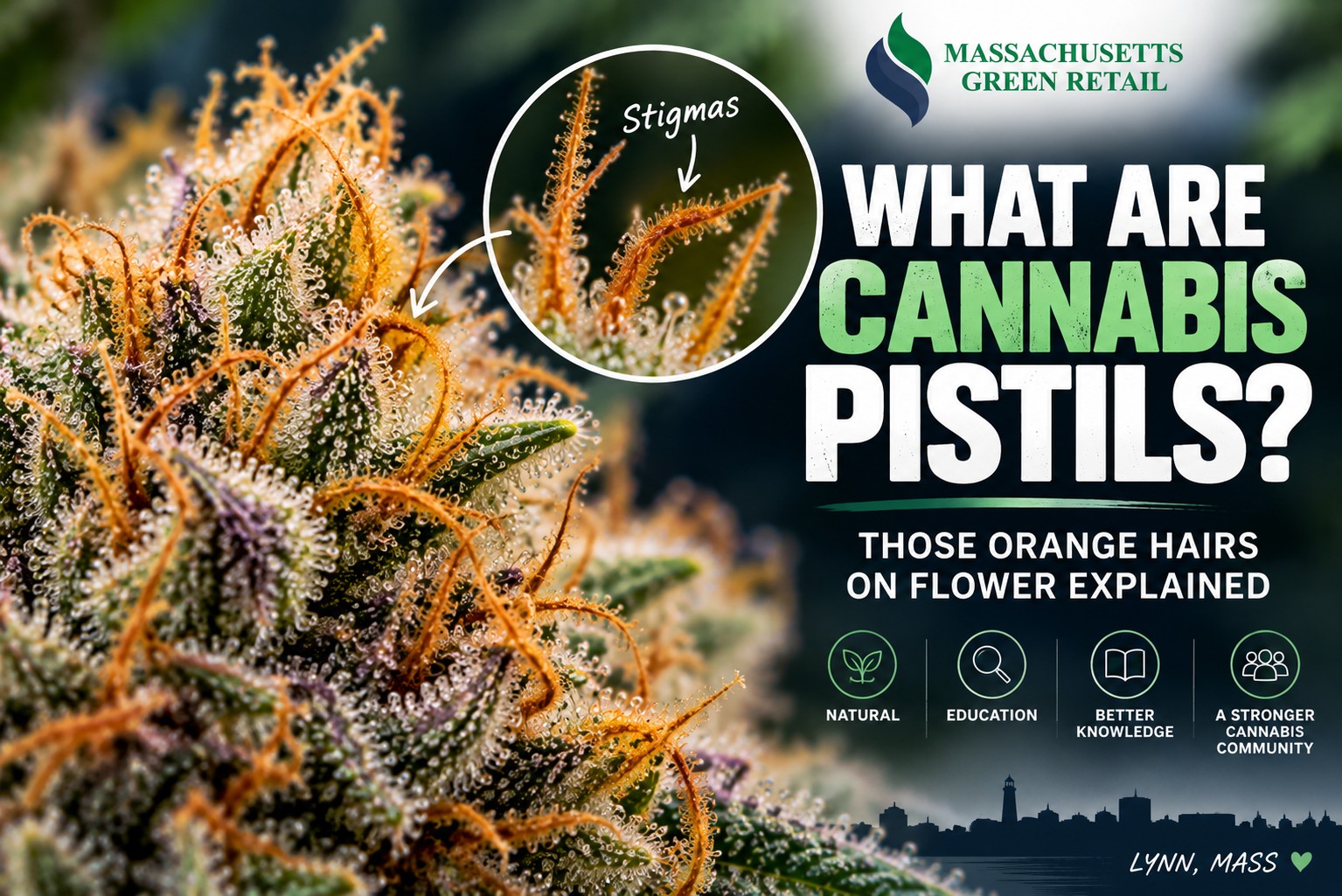
The pistil contains multiple parts, including an ovary and stigmas. The thin hair-like structures visible on the outside of the flower are the stigmas.
In everyday cannabis terminology, however, people often use “pistils” and “pistil hairs” to describe those visible strands. So when someone talks about the orange pistils on a cannabis bud, they’re usually talking about the stigmas.
Their natural job has nothing to do with making cannabis look interesting.
Stigmas help the female cannabis plant capture pollen.
If pollen from a male plant reaches a receptive stigma, it can lead to fertilization and seed development. Cannabis cultivated primarily for flower production is generally managed to avoid unwanted pollination so that the female plants continue developing unseeded flowers.
Why Are Cannabis Pistils White at First?
The color of these hairs changes as the flower develops.
During earlier stages of flowering, stigmas commonly emerge as thin white or cream-colored strands. As the plant matures, many of them gradually darken.
Depending on the plant and its genetics, they may eventually become:
Orange
Amber
Red
Rust-colored
Brown
This transformation is part of the flower’s development.
That’s why photographs of younger cannabis flowers often show bright white hairs sticking outward, while mature dried cannabis flower may have darker orange or brown strands curled into the bud.
Why Does Cannabis Have Orange Hairs?
The orange color is largely the result of the stigmas changing as the flower matures.
Genetics play an important role in how those colors ultimately appear. Some cultivars develop especially bright orange hairs, while others may lean toward reddish, golden, or darker brown shades.
Growing conditions and the stage of plant development can also influence what you see.
After harvest, drying and curing further change the flower’s overall appearance. By the time cannabis reaches a licensed dispensary, those once-white stigmas may look very different from how they appeared while the plant was actively flowering.
The result is the familiar orange-haired cannabis bud many consumers recognize.
Are Orange Hairs the Same as Trichomes?
No.
This is one of the easiest cannabis features to confuse when you’re first learning about flower.
Stigmas are the longer hair-like strands that can turn orange or brown.
Trichomes are much smaller resin-producing structures covering parts of the flower. To the naked eye, dense trichome coverage often makes a bud look frosty or crystal-coated.
Under magnification, many glandular trichomes look more like tiny stalks with rounded heads than hairs.
These structures also serve very different purposes for the plant.
The visible stigmas are associated with reproduction and capturing pollen. Glandular trichomes are associated with the production and storage of resin containing cannabinoids and aromatic compounds.
If a cannabis bud looks both orange and frosty, you’re probably seeing both structures at the same time.
Do More Orange Hairs Mean More THC?
No.
You cannot reliably determine the THC content of cannabis flower by counting its orange hairs or judging their color.
A bud covered with bright orange stigmas isn’t necessarily stronger than a bud with fewer visible ones.
The appearance of stigmas is influenced by factors such as genetics and plant maturity. THC concentration, meanwhile, needs to be evaluated through laboratory testing rather than visual inspection.
Massachusetts cannabis products sold through licensed retailers include required labeling and testing information that provides much more useful information than appearance alone.
So if you’re comparing two jars of cannabis flower, don’t assume the one with more orange hairs contains more THC.
Do Orange Pistils Mean Cannabis Is Better Quality?
Not necessarily.
Orange stigmas can make cannabis flower visually striking, but they’re not a universal quality indicator.
Flower quality is more complicated than any single visual characteristic.
A consumer might consider the flower’s aroma, moisture level, structure, packaging information, cultivator, cannabinoid profile, freshness, price, and their own preferences.
The same principle applies to trichomes.
A very frosty bud can look impressive, but appearance by itself doesn’t tell you everything about how the flower was cultivated, stored, handled, or how an individual will experience it.
Cannabis is one of those products where it’s easy to judge with your eyes first. Understanding what you’re actually seeing makes those visual characteristics much more useful.
Can Pistil Color Tell Growers When Cannabis Is Ready to Harvest?
Growers sometimes observe changes in stigma color as one of several signs of flower development, but stigma color alone isn’t a precise harvest clock.
A flower with many darkened stigmas may be further along in its development than one covered primarily in fresh white stigmas, but genetics and growing conditions can affect those appearances.
Cultivators may therefore evaluate multiple characteristics of the plant rather than relying solely on whether the hairs have turned orange.
For consumers buying finished cannabis flower, pistil color is even less useful as an indication of when the product was harvested.
The dates and information printed on the package provide better context about the finished product.
Why Do Some Cannabis Strains Have More Orange Hairs Than Others?
Genetics are a major reason.
Cannabis cultivars can look dramatically different from one another. Some produce compact dark-green buds covered in orange strands. Others may have lighter flower, purple coloration, fewer prominent stigmas, or a much frostier overall appearance.
Bud structure can also change how visible the hairs are.
On some flower, the stigmas extend noticeably beyond the surrounding plant material. On other flower, they curl inward and become less visually prominent.
That doesn’t automatically make one better than the other.
It’s simply part of the enormous amount of visual variation found within cannabis.
What Can You Actually Learn by Looking at Cannabis Flower?
Quite a bit—as long as you understand the limits.
Visible trichomes can explain why flower looks frosty. Stigmas explain many of the orange hairs. Genetics help explain differences in color and bud structure.
You might also notice whether flower appears extremely dry, compressed, leafy, unusually loose, or physically damaged.
What you can’t reliably determine just by looking is exactly how potent the flower is or how it will affect you.
That’s where product labeling, laboratory testing, knowledgeable dispensary staff, and your own previous experiences become much more useful.
Learning the anatomy simply helps you understand what you’re looking at.
Learning More About Cannabis Flower at Massachusetts Green Retail
The next time you’re looking at cannabis flower, take a closer look.
Those orange hairs aren’t decoration. They’re remnants of an important part of the female cannabis flower’s reproductive system. The frosty coating surrounding them is something different entirely.
Understanding distinctions like these can make shopping at a cannabis dispensary in Lynn, MA a little less confusing—especially if you’re still learning how to compare flower.
Massachusetts Green Retail carries a rotating selection of cannabis flower from licensed Massachusetts cultivators. Our team can help explain product labels, different cultivars, package sizes, current testing information, and other characteristics when you’re comparing options.
Adults 21+ can browse the current MGR menu and order cannabis online for North Shore pickup or visit Massachusetts Green Retail in Lynn.
 Massachusetts Green Retail Inc. offers a wide variety of top-notch recreational products at unbeatable prices, all while staying committed to our local roots! Shop online for pickup and come visit us to discover not only amazing deals but also a friendly atmosphere where our knowledgeable team is ready to help you find exactly what you need for a great experience.