Look closely at a piece of cannabis flower and you’ll see that a bud isn’t one solid structure.
There are orange or brown hairs, a coating of tiny trichomes, tightly clustered flower material, and sometimes small pointed leaves sticking out from the bud.
Those little leaves are commonly called sugar leaves.
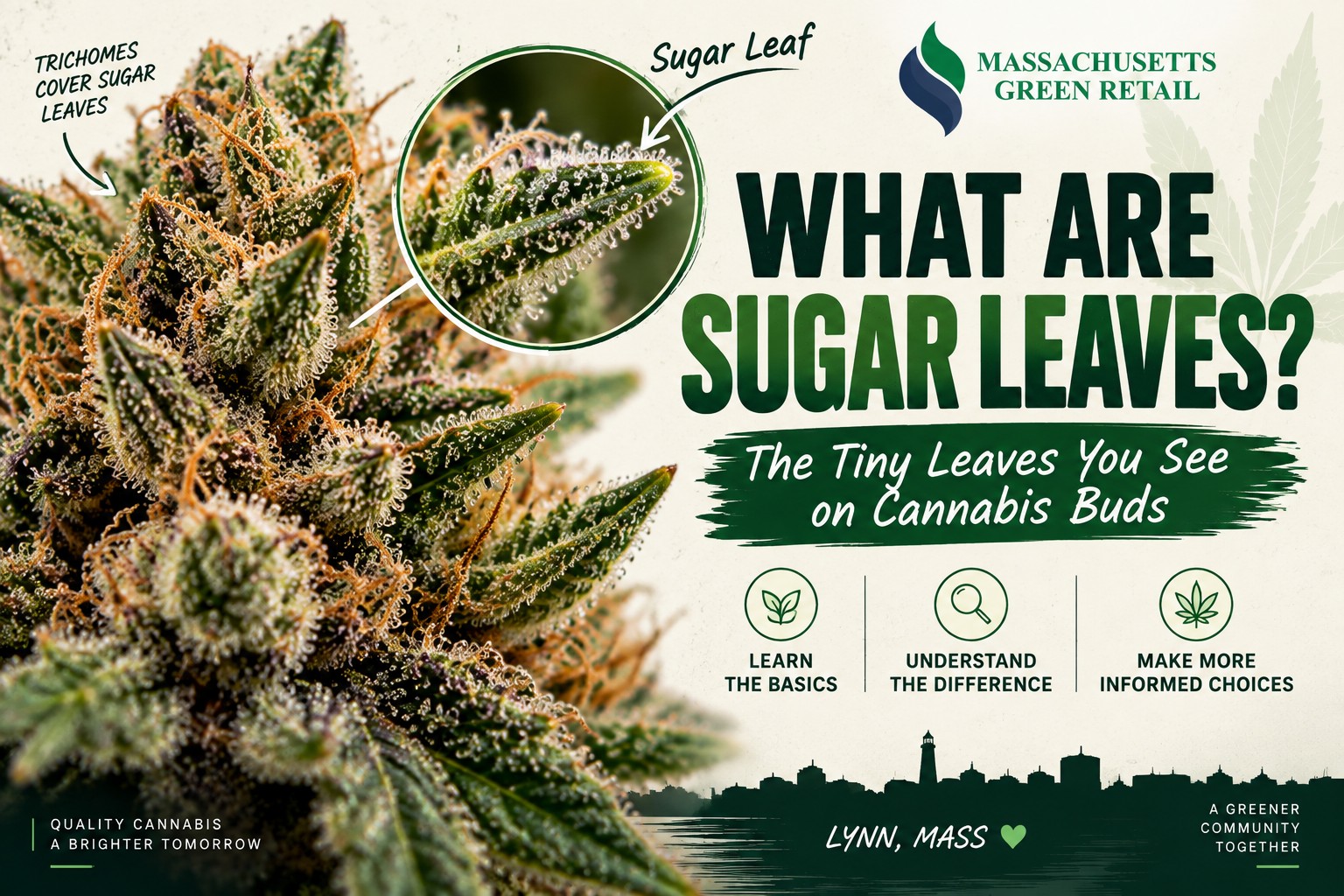
They’re a normal part of the cannabis plant, and their name comes from the frosty layer of trichomes that can make them appear as though they’ve been dusted with sugar.
But why are they there? Why are some removed before cannabis reaches a dispensary while others remain? And does seeing sugar leaves mean you’re getting lower-quality flower?
Here’s what they actually are.
What Are Cannabis Sugar Leaves?
Sugar leaves are small leaves that grow within and around cannabis flowers.
Unlike the large, recognizable leaves you might associate with a cannabis plant, sugar leaves are much smaller and develop close to the flower itself.
As flowering progresses, these leaves can become surrounded by resin-producing trichomes.
Under the right lighting, that trichome coverage gives the leaves a sparkling or crystalline appearance.
That’s where the nickname “sugar leaves” comes from.
There isn’t actual sugar on the plant. The sugary appearance comes from the tiny trichomes covering the surface.
Sugar Leaves vs. Fan Leaves: What’s the Difference?
Cannabis plants produce different kinds of leaves.
Fan leaves are the large leaves extending outward from the plant. They’re usually what people picture when they imagine the classic cannabis leaf.
Sugar leaves are much smaller and grow directly around the flowers.
The distinction becomes especially important during harvest.
Large fan leaves are generally removed because they’re not the portion of the plant being prepared as finished cannabis flower. Sugar leaves require a little more attention because they’re intertwined with the buds.
Some may be trimmed away, while small portions may remain on the finished flower.
Why Do Sugar Leaves Look Frosty?
For the same reason cannabis buds can look frosty: trichomes.
Glandular trichomes are tiny structures found in high concentrations around cannabis flowers and nearby plant material.
Sugar leaves can develop substantial trichome coverage because of how close they grow to the flower.
To the naked eye, those trichomes can look like tiny white crystals.
Under magnification, however, many glandular trichomes look more like microscopic stalks topped with rounded heads.
These structures contain resin produced by the cannabis plant, including cannabinoids and aromatic compounds.
That’s why sugar leaves aren’t necessarily treated like ordinary plant waste after they’re trimmed.
Why Are Sugar Leaves Trimmed Off Cannabis Buds?
After cannabis is harvested and dried, flower is typically trimmed before being packaged.
Trimming removes excess leafy plant material and gives individual buds the more familiar shape consumers see at a cannabis dispensary.
Sugar leaves are part of that process.
Cultivators can trim flower by hand, use mechanical trimming equipment, or use a combination of techniques.
How aggressively the flower is trimmed can vary.
One cultivator may leave small portions of heavily frosted sugar leaves attached, while another may trim flower very closely.
That can make two perfectly normal cannabis products look quite different.
Are Sugar Leaves Bad?
No.
Seeing a small sugar leaf on cannabis flower doesn’t automatically indicate poor quality.
They’re a natural part of the plant.
The more useful question is how much leafy material remains relative to the flower itself.
A few small, trichome-covered leaves are very different from a bud surrounded by excessive amounts of unwanted plant material.
Trimming style also matters. Some cultivators favor a very clean, tightly manicured appearance, while others may leave slightly more of the natural flower structure intact.
Appearance alone isn’t enough to determine the overall quality of cannabis flower.
Do Sugar Leaves Contain THC?
Sugar leaves can contain cannabinoids because they can carry glandular trichomes.
However, cannabinoid concentration isn’t necessarily identical across every part of the cannabis plant.
The flower itself is the primary product consumers are purchasing when they buy packaged cannabis flower.
This is also why you shouldn’t try to estimate potency by counting sugar leaves or judging how frosty they appear.
Licensed cannabis products are laboratory tested, and the information on the package provides a much better basis for understanding cannabinoid content than visual inspection.
What Happens to Sugar Leaves After They’re Trimmed?
This is where sugar leaves become especially interesting.
Because trimmed sugar leaves can contain resinous trichomes, cannabis producers may collect this material rather than simply discarding it.
Depending on the producer and manufacturing process, cannabis trim can potentially be used as input material for other cannabis products.
This also helps explain why the cannabis industry distinguishes between different portions of harvested plant material.
Not everything removed during trimming has the same characteristics.
A large fan leaf and a heavily frosted sugar leaf are both leaves, but they’re very different in their relationship to the cannabis flower.
Do More Sugar Leaves Mean Better Cannabis?
No.
Just like dense buds, purple coloration, orange pistils, or an especially frosty appearance, sugar leaves are only one visible characteristic of cannabis.
More isn’t automatically better.
A heavily trimmed bud might have very few visible sugar leaves. Another cultivator’s flower might retain several small ones.
Neither observation tells you exactly how potent the flower is or how you’ll experience it.
When comparing cannabis flower, look at the product as a whole rather than searching for one visual feature that’s supposed to identify the “best” option.
Sugar Leaves, Pistils, and Trichomes Are Different Things
If you’ve been following our cannabis flower guides, you can now identify several structures on a bud.
Sugar leaves are the small leaves growing around the flower.
The orange, red, or brown hairs you commonly see are stigmas, which are part of the female flower’s reproductive structures and are often casually referred to as pistils.
The tiny crystal-like structures responsible for the frosty appearance are trichomes.
You’ll often see all three at once.
That’s why a cannabis bud can look so complex under magnification. What appears to be one small piece of flower actually contains several different plant structures layered together.
What Should You Look for When Buying Cannabis Flower?
Understanding cannabis anatomy can help you recognize what you’re seeing, but you don’t need to inspect every leaf before choosing flower.
Instead, consider the complete product.
Look at the cultivator, cannabinoid information, packaging dates, flower condition, price, genetics, and your previous experiences with similar products.
If you’re using a cannabis guide for beginners, learning terms such as trichomes, pistils, and sugar leaves can also make product descriptions and dispensary conversations easier to understand.
Most importantly, don’t assume one unusual-looking feature automatically means something is wrong.
Cannabis is a plant, and natural variation is normal.
Learn More About Cannabis Flower at Massachusetts Green Retail
The next time you’re looking at cannabis flower at a cannabis dispensary in Lynn, MA, take a closer look at the bud.
Those tiny leaves tucked between the flower aren’t necessarily leftover debris. They’re sugar leaves—part of the plant’s natural flower structure and often home to visible trichomes.
Massachusetts Green Retail carries a rotating selection of cannabis flower from licensed Massachusetts cultivators, giving adult customers an opportunity to compare different genetics, structures, trimming styles, potency ranges, and price points.
Adults 21+ can browse the current MGR menu to order cannabis online for North Shore pickup or visit Massachusetts Green Retail in Lynn.
Responsible Use
Cannabis is for adults 21 and older. Flower appearance, sugar leaves, trichome coverage, strain name, or THC percentage cannot predict exactly how a product will affect an individual. Start conservatively with unfamiliar cannabis, don’t drive or operate machinery while impaired, and store cannabis securely away from children and pets.
 Massachusetts Green Retail Inc. offers a wide variety of top-notch recreational products at unbeatable prices, all while staying committed to our local roots! Shop online for pickup and come visit us to discover not only amazing deals but also a friendly atmosphere where our knowledgeable team is ready to help you find exactly what you need for a great experience.