
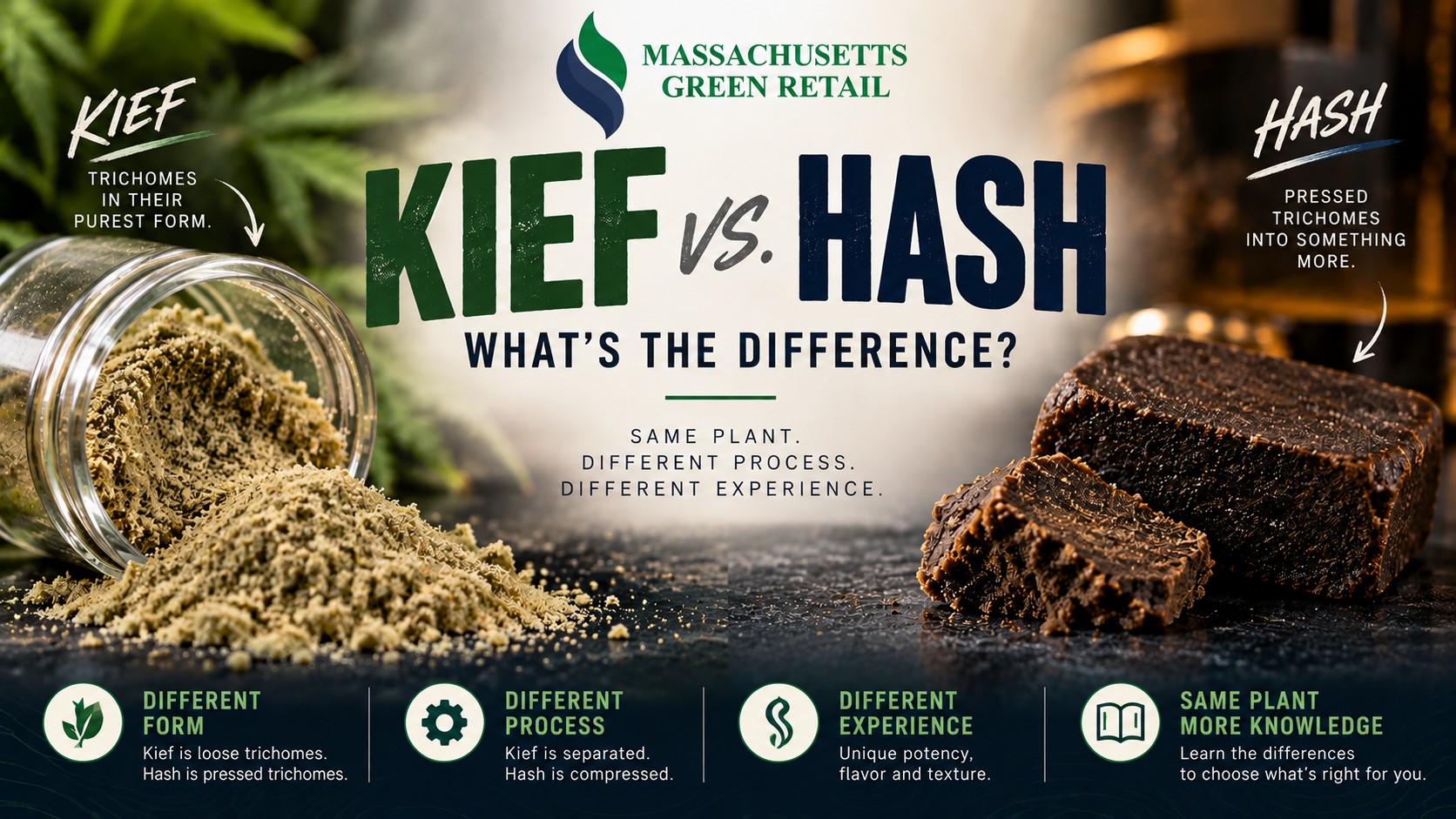
Kief and hash are closely related cannabis concentrates, but they are not exactly the same product.
Kief is the loose, powdery material collected when trichomes separate from cannabis flower. Hash is generally made by collecting that trichome-rich material and processing or compressing it into a more cohesive form.
Both can be produced without chemical solvents. Their appearance, texture, potency, aroma, and intended use can still vary considerably depending on the starting flower and production method.
What Is Kief?
Kief consists largely of separated cannabis trichomes, along with varying amounts of plant material.
Trichomes are the tiny glandular structures that give cannabis flower much of its frosty appearance. They produce and store cannabinoids, terpenes, and other plant compounds. When dried flower is handled or moved across a fine screen, some of these brittle structures can break away from the flower.
The resulting material may look like:
- Fine powder
- Coarse sand
- Tiny golden or green particles
- Loose crystals collected in the bottom of a grinder
Color can range from pale cream or tan to greenish brown. A greener product may contain more leaf or other plant material, although color alone cannot establish purity or quality.
Researchers studying mechanical cannabis separation describe kief as a powder containing glandular trichomes as well as varying quantities of trichome stalks, plant fragments, and other particles. Review the 2025 trichome-separation study.
How Is Kief Collected?
Commercial kief is commonly produced using dry-sifting equipment.
Dried cannabis moves across screens with openings sized to let small particles and trichomes pass through. Producers may sift the material several times or use multiple screen sizes to refine the final product.
Temperature, dryness, movement, screen size, starting material, and the number of separation passes can all influence the result.
Kief also collects naturally in grinders equipped with screened lower chambers. Grinder kief, however, is not necessarily equivalent to a regulated concentrate produced with controlled commercial equipment. Its composition may vary depending on the flower, grinder screen, cleanliness, and length of collection.
What Is Hash?
“Hash” or “hashish” describes a broad family of products made from concentrated cannabis trichomes.
Traditional hash may be created by collecting kief and applying pressure, heat, or both. This transforms loose material into a block, ball, patty, or pliable piece.
Hash can range from dry and crumbly to soft, sticky, or firm. It may appear blonde, tan, brown, green, reddish, or nearly black.
The word does not identify one standardized production method. Two products labeled hash may have very different textures and cannabinoid profiles.
What Is Dry-Sift Hash?
Dry-sift hash begins with mechanically separated kief.
After sifting, the collected material may be refined and then pressed. Depending on the temperature, pressure, and trichome composition, pressing can create a product that holds together more firmly than loose kief.
Some dry-sift hash remains sandy or crumbly. Other versions become dense or pliable.
Because the method relies primarily on screens and mechanical separation, it is generally categorized as solventless extraction. A scientific review of cannabis processing describes dry sieving as a method that separates trichomes from dried plant material; the collected kief can then be pressed into hashish. Read the processing-method review.
What Is Bubble Hash?
Bubble hash—also called ice-water hash—is produced using cold water, ice, agitation, and filtering bags or screens.
Cold temperatures make trichomes more brittle. Agitation helps separate them from the plant, while filters collect different particle sizes. The resulting material must then be dried carefully.
“Bubble” does not mean the concentrate contains carbonation. The name is commonly associated with how certain high-quality samples may bubble when heated.
Bubble hash can differ in:
- Trichome content
- Remaining plant material
- Particle size
- Texture
- Melt characteristics
- Aroma
- Cannabinoid concentration
Terms such as “full melt” may be used to describe how completely a particular hash melts, but shoppers should not treat informal grading language as a substitute for package information and laboratory results.
Is Hash Rosin the Same as Hash?
No.
Hash rosin starts with hash—often ice-water hash—that is placed between filter material and pressed using controlled heat and pressure. The process expresses a resinous oil from the hash.
Traditional pressed hash retains the collected trichome material in a solid or semi-solid form. Hash rosin is the extract released from that material during pressing.
Both may be described as solventless, but they differ in processing, texture, handling, and how they are commonly consumed.
Is Kief or Hash Stronger Than Flower?
Kief and hash are concentrated products, so they may contain substantially more THC by weight than the flower from which they were produced. However, neither name provides a dependable potency number.
Results depend on:
- Starting flower
- Trichome maturity
- Separation efficiency
- Amount of plant material
- Refinement method
- Production batch
- Storage and handling
Kief is not automatically weaker than hash, and dark hash is not automatically stronger than blonde hash. Check the cannabinoid results on the current package instead of estimating potency from appearance or texture.
How Are Kief and Hash Used?
Depending on the product and manufacturer’s directions, adults may add a small amount of kief or hash to flower. Certain concentrates may also be intended for compatible concentrate vaporizers or other purpose-built equipment.
Do not assume that every product works with every device. Texture and melt characteristics can affect whether a particular concentrate is appropriate for a vaporizer, dab rig, pipe, or flower bowl.
Avoid using improvised heating devices. Ask a budtender about compatibility and follow the equipment manufacturer’s instructions.
How Should These Concentrates Be Stored?
Keep kief and hash sealed in their original containers in a cool, dry, dark location.
Loose kief can spill easily and may cling to containers or tools. Hash may soften, become sticky, dry out, or lose aroma when exposed to unsuitable temperatures, air, or light.
Use clean tools and minimize unnecessary handling. Store all cannabis securely away from children, pets, and anyone younger than 21.
What Should Shoppers Compare?
Before choosing kief or hash, review:
- Production method
- Starting material or cultivar
- Cannabinoid results
- Available terpene information
- Net weight
- Ingredients
- Testing and packaging dates
- Texture and storage directions
- Recommended equipment
Time-sensitive Massachusetts note—verified September 9, 2026: Cannabis products sold by licensed Massachusetts retailers remain subject to current testing, packaging, and labeling requirements. Review the current Cannabis Control Commission regulations and the information printed on the specific package.
Explore Concentrates at Massachusetts Green Retail
Massachusetts Green Retail carries a changing selection of concentrates and flower products from licensed Massachusetts producers.
Adults visiting our cannabis dispensary in Lynn, MA can compare concentrate types, production methods, cannabinoid results, package sizes, and hardware requirements with help from the MGR team.
Browse the Massachusetts Green Retail menu to order cannabis online for North Shore pickup, or visit us at 829 Boston Street in Lynn.
Responsible-Use Note
Cannabis is intended only for adults 21 years of age or older. Concentrates may contain substantially more THC by weight than flower, so begin conservatively with an unfamiliar product. Never drive or operate machinery while impaired, and keep all cannabis sealed and securely stored away from children and pets.
 Massachusetts Green Retail Inc. offers a wide variety of top-notch recreational products at unbeatable prices, all while staying committed to our local roots! Shop online for pickup and come visit us to discover not only amazing deals but also a friendly atmosphere where our knowledgeable team is ready to help you find exactly what you need for a great experience.