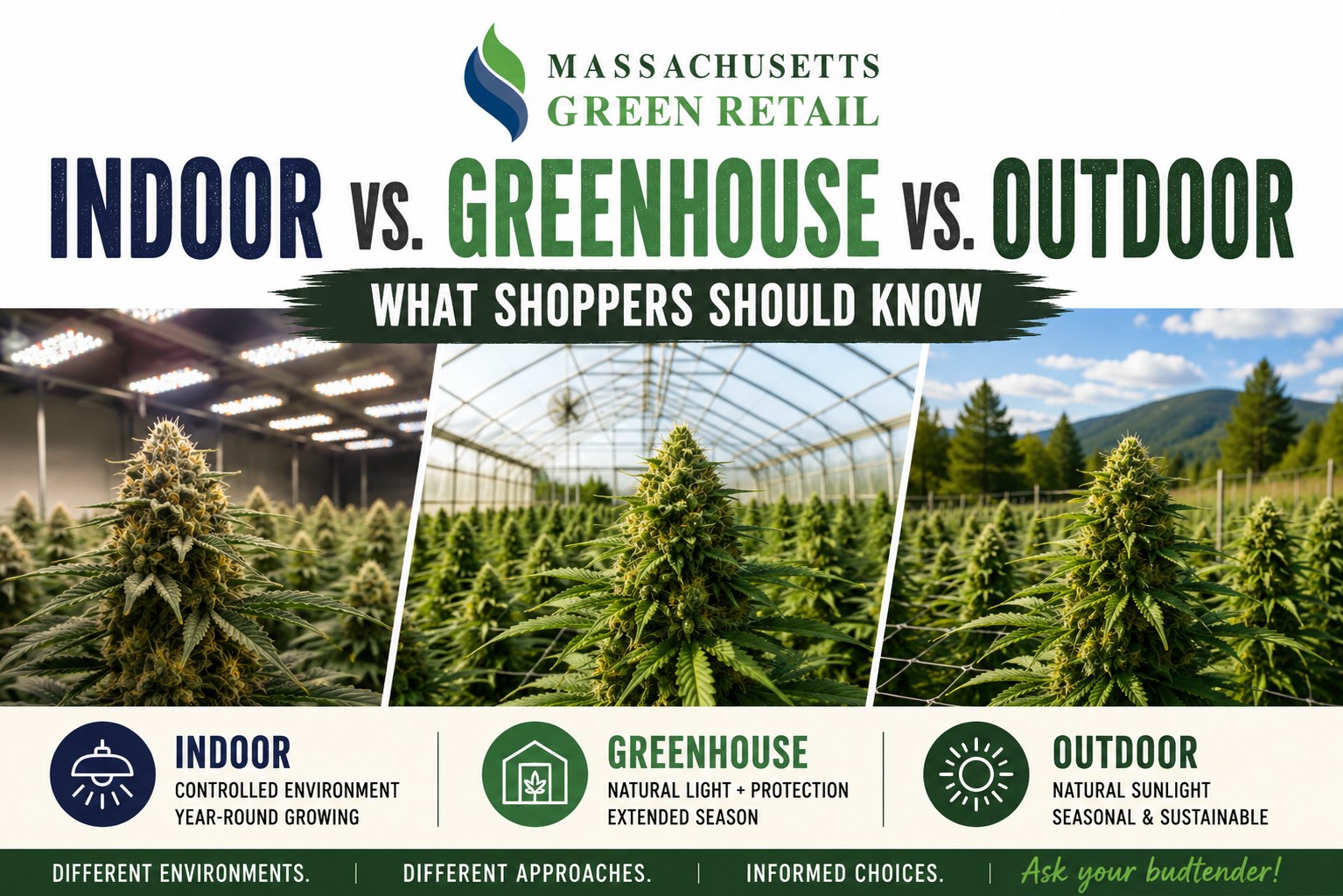
Indoor, greenhouse, and outdoor cannabis are distinguished mainly by where plants grow and how cultivators manage light, temperature, humidity, and seasonal conditions. These environments can influence the finished flower, but no cultivation method automatically guarantees greater potency or quality.
The producer, genetics, harvest, curing, testing, packaging, and storage all matter too.
What Is Indoor-Grown Cannabis?
Indoor cannabis is cultivated inside an enclosed facility using artificial lighting and managed environmental systems.
Cultivators can adjust factors such as:
- Light intensity and schedule
- Temperature
- Humidity
- Air movement
- Irrigation
- Nutrient delivery
- Plant spacing
- Pest-management practices
This level of control may allow growers to maintain relatively consistent conditions throughout the year. Indoor facilities can also support multiple harvest cycles without relying entirely on Massachusetts’ outdoor growing season.
However, control does not guarantee a perfect product. Indoor cultivation still requires careful plant care, sanitation, harvesting, drying, curing, packaging, and storage.
Problems at any stage can affect the finished flower.
What Is Outdoor-Grown Cannabis?
Outdoor cannabis grows primarily under natural sunlight and seasonal weather conditions.
Cultivators must work with changing day length, temperature, rain, humidity, wind, soil conditions, and the local growing season. Unlike a sealed indoor room, an outdoor environment cannot be adjusted with the same degree of precision.
Potential characteristics of outdoor cultivation include:
- Full-spectrum natural sunlight
- Greater exposure to seasonal variation
- Fewer opportunities for year-round harvests
- More direct interaction with soil and weather
- Less reliance on energy-intensive artificial lighting
Outdoor does not mean unmonitored or poorly managed.
Licensed cultivators may use fencing, irrigation, soil testing, pest controls, weather monitoring, and carefully planned harvest schedules.
Likewise, outdoor-grown flower is not automatically weaker, less attractive, or lower quality than indoor flower. The outcome depends heavily on genetics, climate, cultivation practices, harvest timing, and post-harvest handling.
What Is Greenhouse-Grown Cannabis?
Greenhouse cultivation sits between fully indoor and open-field production.
A greenhouse uses transparent walls or roofing to capture natural sunlight while providing plants with more protection and environmental control than an uncovered field.
Some facilities supplement sunlight with artificial lighting or use heating, ventilation, shades, fans, and humidity controls.
Greenhouse cultivation may offer:
- Natural sunlight
- Protection from heavy rain and wind
- A longer growing season
- Partial temperature and humidity management
- Lower lighting demands than fully indoor production
- More control than an open outdoor field
Not every greenhouse operates the same way.
One facility may depend almost entirely on sunlight, while another uses sophisticated climate controls and supplemental lighting. The word “greenhouse” therefore does not describe one standardized production system.
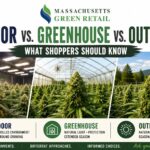
Indoor vs. Greenhouse vs. Outdoor
Indoor Cannabis
Indoor cultivation usually offers the greatest environmental control.
Growers can closely manage lighting, temperature, humidity, irrigation, and airflow. This may support consistency between harvests and year-round production.
Greenhouse Cannabis
Greenhouses combine natural sunlight with varying levels of environmental management.
They provide more weather protection than outdoor cultivation while potentially reducing the need for artificial lighting compared with fully indoor facilities.
Outdoor Cannabis
Outdoor cultivation relies heavily on natural sunlight and seasonal conditions.
Growers have less ability to control the environment but can take advantage of direct sunlight and larger outdoor spaces.
None of these methods automatically produces the best cannabis.
Can the Growing Environment Change the Flower?
Yes.
Growing conditions can influence plant development and chemical composition.
A peer-reviewed study comparing genetically identical cannabis plants grown indoors and outdoors found measurable differences in some cannabinoids and terpenes. Importantly, the researchers did not conclude that one environment universally produces a better product.
The results involved particular plants and growing conditions and should not be applied to every cannabis cultivar.
Light, temperature, nutrients, irrigation, plant structure, harvest timing, and other variables can interact with genetics.
Two cultivators starting with related genetics may therefore produce flower that differs in:
- Appearance
- Aroma
- Cannabinoid results
- Terpene profile
- Bud structure
- Density
Cultivation method is part of the story—not the complete explanation.
Does Indoor Cannabis Always Have More THC?
No.
Indoor cultivation gives producers considerable environmental control, but the term indoor does not tell you the finished product’s THC percentage.
Outdoor and greenhouse cannabis can also test across a wide range of cannabinoid levels.
Instead of predicting potency from the growing environment, check the package for:
- THC and THCA
- CBD and CBDA
- Other reported cannabinoids
- Testing date
- Package date
- Batch information
- Net weight
- Producer information
The highest THC result is not automatically the best choice.
Potency should be considered alongside your experience level, product preferences, terpene profile, and serving amount.
Does One Growing Method Produce Better Flavor?
Not automatically.
Cannabis aroma and flavor depend partly on terpenes, but terpene development and preservation can be affected by many stages of the production process.
These include:
- Genetics
- Growing conditions
- Harvest timing
- Drying
- Curing
- Trimming
- Packaging
- Transportation
- Storage
Carefully cultivated flower can lose aroma if it is dried too quickly or stored improperly.
At the same time, well-handled flower grown in any environment may retain a strong and distinctive terpene profile.
If aroma and flavor are important to you, review reported terpene information when available and consider the packaging date.
Does Indoor Cannabis Look Better?
Indoor cannabis is sometimes associated with tightly structured, visually polished buds because growers can closely control environmental conditions.
However, appearance varies considerably.
Outdoor flower may have:
- Different bud structures
- More variation in color
- Larger buds
- Different leaf structure
Greenhouse flower may fall somewhere between typical indoor and outdoor characteristics.
Visual appearance alone cannot determine product quality.
A beautiful bud may still be dry, old, poorly stored, or simply not fit your personal preferences.
What Should Shoppers Look At?
Instead of choosing flower solely because the label says indoor, greenhouse, or outdoor, consider the complete product.
Ask:
- Who cultivated it?
- When was it packaged?
- When was it tested?
- What cannabinoids are reported?
- Are terpene results available?
- Is it whole or ground flower?
- Is the container sealed correctly?
- Have you previously enjoyed products from this cultivator?
These details provide more useful information than cultivation method alone.
Questions to Ask Your Budtender
If you are curious about how flower was grown, consider asking:
- Was this grown indoors, outdoors, or in a greenhouse?
- Does the producer provide cultivation information?
- What are the dominant terpenes?
- When was this batch packaged?
- How does it compare with another flower from the same producer?
- Is this a newer harvest?
- What stands out about this product besides THC percentage?
A knowledgeable budtender can help compare available options without treating one cultivation method as automatically superior.
Explore Cannabis Flower at Massachusetts Green Retail
Massachusetts Green Retail carries a changing selection of flower from licensed Massachusetts producers.
Adults visiting our cannabis dispensary in Lynn, MA can compare cultivators, package dates, cannabinoid profiles, terpene information, and flower formats with help from the MGR team.
As a recreational cannabis dispensary serving the North Shore, we want customers to understand what makes cannabis products different instead of simply following labels or assumptions.
Browse the Massachusetts Green Retail online menu to see what flower is currently available, or visit us at 829 Boston Street in Lynn.
Final Thoughts
Indoor, greenhouse, and outdoor cannabis are different cultivation approaches—not quality grades.
Indoor growing provides extensive environmental control. Outdoor cultivation relies more heavily on natural sunlight and seasonal conditions. Greenhouse cultivation combines elements of both.
Each method can produce excellent cannabis when paired with strong genetics, careful cultivation, proper harvesting, thoughtful curing, accurate testing, and appropriate storage.
The next time you compare flower, look beyond the growing environment.
Check the cultivator, current batch, cannabinoids, terpene information, package date, and overall product condition before deciding what belongs in your cart.
Responsible-Use Note
Cannabis products are intended only for adults 21 years of age or older. Store all cannabis securely away from children and pets. Begin conservatively with unfamiliar products, consume only where permitted, and never drive or operate machinery while impaired.
 Massachusetts Green Retail Inc. offers a wide variety of top-notch recreational products at unbeatable prices, all while staying committed to our local roots! Shop online for pickup and come visit us to discover not only amazing deals but also a friendly atmosphere where our knowledgeable team is ready to help you find exactly what you need for a great experience.